Unofficial State College Bus Transit Map
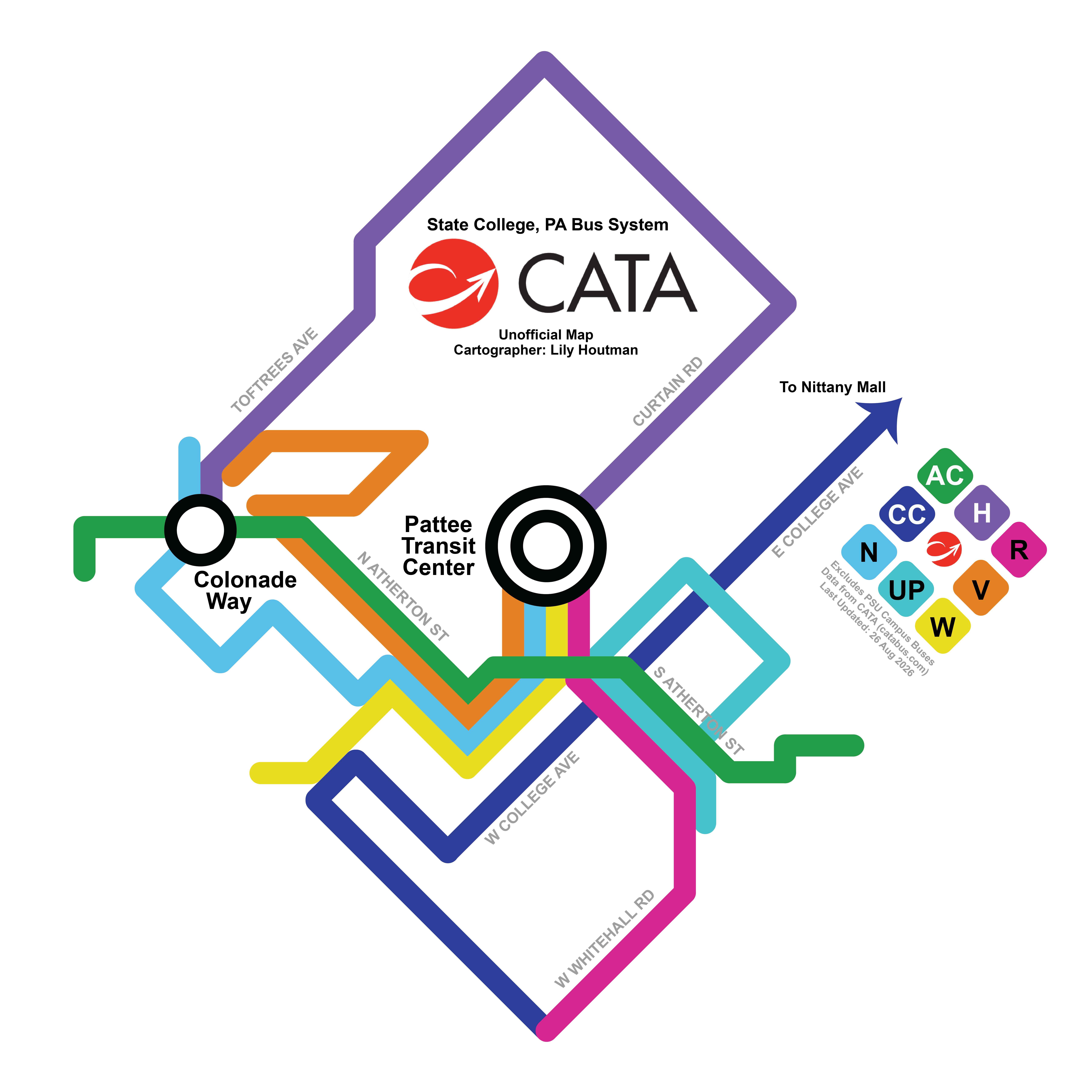
I am a long-time user of the State College public transit system. However, I primarily use the N bus, and I realized that I have limited knowledge of most of the other city buses. As new people move to town, I want to be able to better answer questions about all of the buses in the city. Thus, Inspired but metro transit maps for large cities, I created a transit map for the State College bus system.
This map differs from many classic transit maps. Most transit maps are for train-based systems with common stops. However, in State College, buses are the only form of public transportation. Therefore, I focused on visualizing the routes rather than emphasizing stops. I did highlight two stops: the Pattee Transit Center, where most buses stop, and the stops near Colonade Way, where many of the North Atherton buses stop. I made this map in shape of a diamond rather than a square. When I looked at the CATA website, I noticed that broadly the bus routes best fit this shape, with stops ending in the extreme cardinal directions. The CC bus extends far east, so I opted to cut it short.
I designed this map for a poster format to display in the NACIS 2026 Map Gallery. I have always been inspired by transit maps because they take incredibly complicated data and simplfy it in a way that can be read quickly and easily. The audiences of transit maps are often moving fast, in distracting environments, and may be experiencing emotional distress. Therefore, the user-experience design of transit maps is an incredibly difficult, yet essential, job. I am primarily interested in mobile map design, and the challenges of simple, quick, and effective map design is found in both transit and mobile map design (and of course, many transit maps must be designed for mobile). Taking the time to work on mobile and transit map design has allowed me to think about the overlap in best practices between the two.